

Engineering & production planning
Bridge Manufacturing Comparison: 1,000-Printer FDM Farm vs. Urethane Casting vs. CNC Machining (50 to 2,000 Units)
Compare FDM, urethane casting and CNC for 50 to 2,000 bridge parts. Review mold life, setup costs, finish and first-shipment timing before requesting a quote.
Choose the process around the acceptance criteria
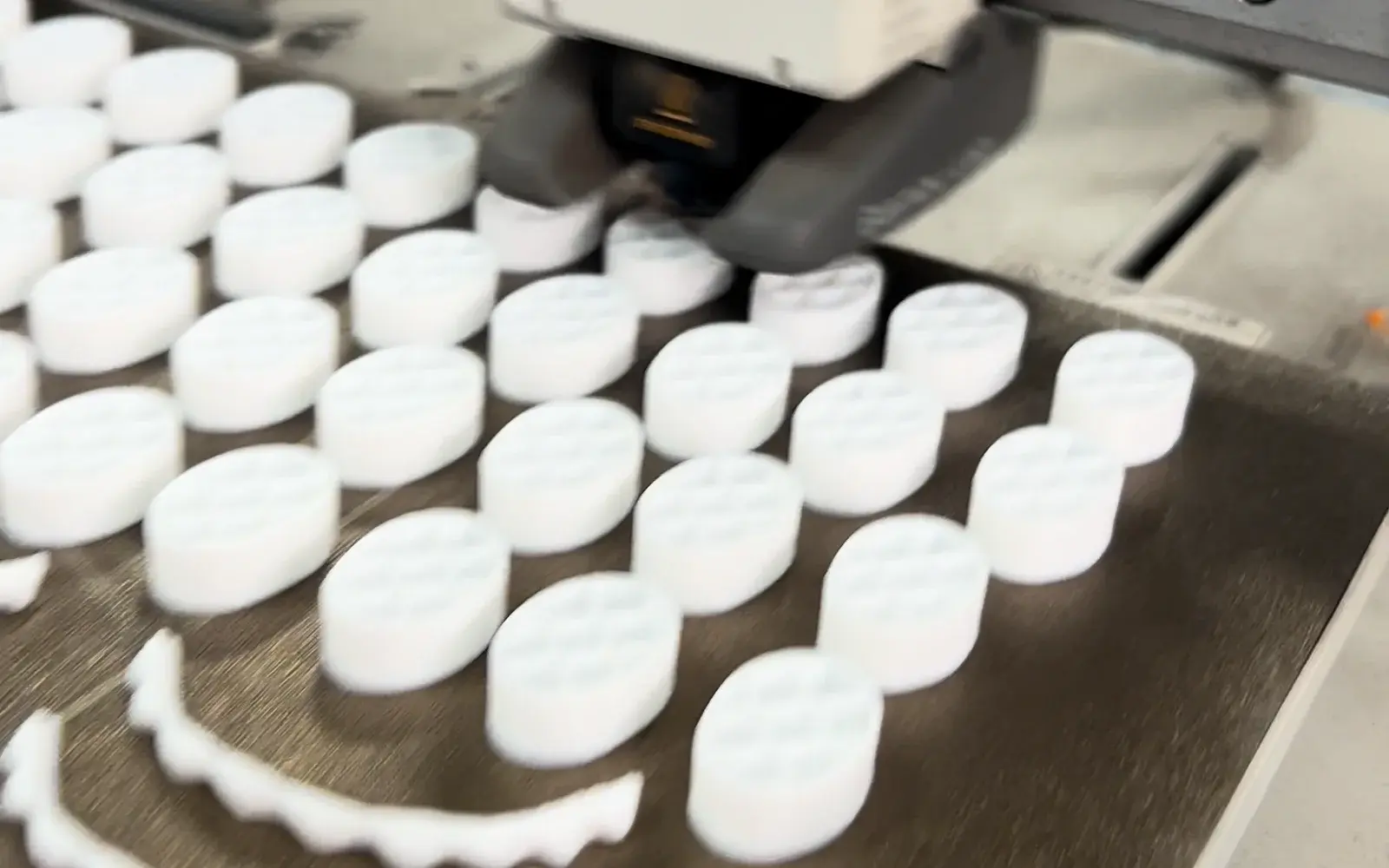
Bridge manufacturing supplies accepted parts while hard tooling, design validation or demand planning continues. QuoteFlow 3D's core route is direct FDM batch production in Houjie, Dongguan; casting and CNC here are purchasing alternatives to compare with qualified suppliers, not a claim of in-house equipment.
FDM suits changing geometries, accessible internal features and distributed small-lot builds. Casting can reproduce a finished master for appearance-focused housings. CNC is a strong candidate when stock-material properties, machined datums or close-fitting interfaces outweigh geometric access and cycle-time costs.
| Decision | Parallel FDM | Urethane casting | CNC machining |
|---|---|---|---|
| Geometry | Complex shells; plan supports and layer loads | Needs a master, split line, venting and demolding | Needs cutter access, workholding and feasible internal radii |
| Surface | Layer texture; finish selected faces if needed | Replicates master finish; trim flash | Tool marks; define cosmetic passes or finishing |
| Material | Production filament grade | Thermoset polyurethane; not identical to ABS or PETG | Stock grade; verify material certification scope |
| Changes | New CAD/profile and sample approval | May require a new master and molds | New program, fixture or setup verification |
Compare 50, 250 and 1,000 units with explicit assumptions
For arithmetic only, assume a compact shell costs $4 per accepted FDM part with no production mold. For casting, assume a $300 master, $150 single-cavity silicone mold, 25 accepted shots per mold and $3 conversion per part. For CNC, assume $400 programming/setup plus $12 per part. These inputs demonstrate amortization; they are not market prices or QuoteFlow offers.
Effective unit cost is total cost divided by accepted quantity. Casting = $300 + ceil(quantity / 25) × $150 + quantity × $3. At 20 accepted shots per mold, mold count increases to 3, 13 and 50 for the three quantities below. Obtain a quote for mold life, cavities, reject allowance and replacement schedule rather than treating 25 shots as guaranteed.
| Accepted quantity | FDM total / unit | Casting molds / total / unit | CNC total / unit |
|---|---|---|---|
| 50 | $200 / $4.00 | 2 / $750 / $15.00 | $1,000 / $20.00 |
| 250 | $1,000 / $4.00 | 10 / $2,550 / $10.20 | $3,400 / $13.60 |
| 1,000 | $4,000 / $4.00 | 40 / $9,300 / $9.30 | $12,400 / $12.40 |
Plan the first accepted shipment and replacement tooling
For an initial scheduling discussion only, allow FDM 1–3 weeks, casting 3–4 weeks and CNC 1–3 weeks from complete inputs to an initial dispatch, including an assumed approval loop and excluding transit. Supplier queues, geometry, finishing and available stock can reverse that order. Request a dated plan, not a universal lead-time promise.
Silicone mold life is often around 20–25 shots for a single-cavity example, with resin, size, geometry and finish affecting replacement. At 2,000 units, the illustrative model needs 80 molds at 25 accepted shots, or 100 at 20. Multi-cavity tooling changes that calculation. Ask which molds run in parallel and how texture or dimensional drift triggers replacement.
FDM avoids mold replacement but still requires released profiles, machine checks and production allocation. CNC setup cost is not a mold charge; programming, fixtures, stock removal, tool wear and multiple setups all remain in the quote.
Split the release when one route does not fit every feature
A practical bridge plan can use printed shells with machined locating components or a separate casting route for appearance-critical covers. Establish ownership of the master, tooling and inspection data, and distinguish printed, cast and machined part revisions in the BOM.
- Compare the same geometry envelope, finished specification and accepted quantity.
- Name critical datums, material properties and cosmetic faces before quoting.
- Ask for sample, first-lot and repeat-lot costs separately.
- Keep bridge approval criteria distinct from the later injection-molded design.
Engineering questions, answered
Which bridge process is best for 50 to 2,000 units?
Use acceptance criteria first: FDM for changing geometries, casting for reproducing a finished master, and CNC for stock-material properties or machined interfaces. Compare the same finished specification.
How many urethane parts can a silicone mold produce?
A commonly cited single-cavity planning range is 20–25 shots, depending on resin, geometry and finish. Obtain a mold replacement schedule and accepted-part allowance from the casting supplier.
What is the FDM versus injection-molding cost crossover?
In our separate example, $4,000–$12,000 tooling divided by a $2 conversion-cost saving gives 2,000–6,000 units. This is a model, not a universal threshold; compare lifetime demand and revisions.
Does zero mold tooling mean no FDM setup charges?
No production mold is required. Engineering work, assembly fixtures, gauges, sampling or finishing setup can still be separately quoted for the project.
Does QuoteFlow 3D manufacture all three processes in-house?
QuoteFlow 3D's core route is direct FDM manufacturing in Houjie, Dongguan. Casting and CNC in this guide are purchasing alternatives to compare with qualified suppliers.
Technical references & calculation basis
Manufacturer references inform design and process review. Cost, schedule and purge examples on this page use the stated planning assumptions; project inputs determine the final production plan.
Your next engineering review
Compare bridge production for my next release
Start with PETG and 500 units. Add your critical dimensions, application and approval requirements to the brief.
Request an engineering reviewPrepare CAD and drawings · Compare FDM materials · Review the QC workflow