

Engineering & production planning
Multi-Color FDM Batch Production: Controlling Purge Waste & Color Consistency at Scale
Calculate AMS purge waste per accepted part, compare full-plate nesting and color-split assembly, and plan consistent colors. Request a multicolor batch quote.
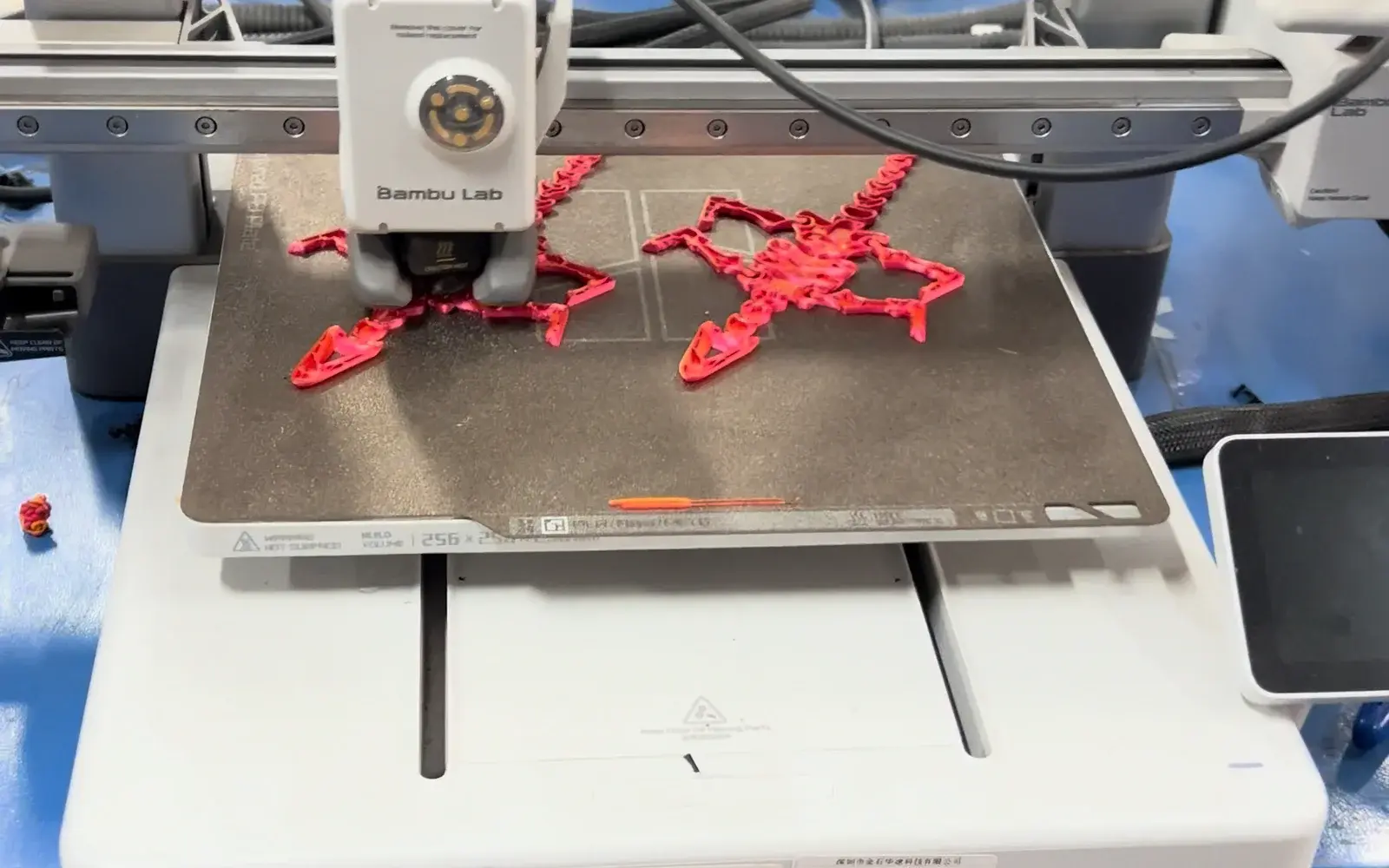
Why plate loading changes multi-color unit economics
On a shared-nozzle AMS workflow, filament changes require flushing to limit color carryover. For layer-by-layer printing of identical copies at matching heights, the same color sequence can serve several objects. Purge demand is tied strongly to the color transitions and layer schedule, so adding copies can spread much of that waste across more accepted parts.
Twenty to forty small identical parts may fit a build plate when footprint, spacing, brims, prime tower and toolhead clearances permit. Larger merchandise may fit only a few parts. Estimate the actual layout in the production slicer; the plate count is a geometric result, not a standard batch capacity. Sequential printing by object has different clearances and can lose shared color-change benefits.
Worked example: from more than 60% to less than 8% purge share
Assume each accepted small part weighs 5 g and each plate uses a fixed 8 g of purge waste with the same layer/color schedule. Purge share here means purge ÷ (useful part mass + purge), not purge divided by useful mass. One part gives 8 ÷ 13 = 61.5%; twenty parts give 8 ÷ 108 = 7.4%; forty give 8 ÷ 208 = 3.8%.
This is a reproducible planning example, not a measured yield claim or a universal AMS saving. Prime tower, brims, supports and rejects must be added to a full cost estimate. If taller geometry or different color placement adds transitions, purge per plate can increase. If a full plate fails, the accepted-part denominator falls.
| Strategy | Parts / plate | Useful mass | Purge mass | Purge / part | Purge share |
|---|---|---|---|---|---|
| Single-piece multi-color | 1 | 5 g | 8 g | 8.00 g | 61.5% |
| Full-plate batch | 20 | 100 g | 8 g | 0.40 g | 7.4% |
| Dense full-plate batch, if geometry fits | 40 | 200 g | 8 g | 0.20 g | 3.8% |
| Color-split assembly | Layout dependent | Sum of separate bodies | Multi-color transitions can be eliminated | Add startup waste and assembly labor | Calculate from the actual process |
Compare full-plate nesting with color-split assembly
Prefer shared-layer nesting when copies have aligned color boundaries and the design benefits from printing as one part. Keep prime-tower placement, bed adhesion and nozzle travel in the production review. Evaluate the cost per accepted part rather than minimizing the purge number alone.
For logos, faces or trim pieces, separating colors into mechanically located bodies may eliminate repeated color changes. The saving must exceed extra print setups, insert/adhesive cost, assembly labor and inspection. Design locating features and specify fit, adhesive compatibility, durability and visible seam criteria. Small loose parts also add counting and packing work.
- Quote one-piece AMS and separate-color assembly against the same approved appearance reference.
- Record all material consumption, machine time, labor and reject assumptions.
- Keep batch layouts within validated clearances and cooling behavior.
- Verify purge-to-infill choices do not bleed through light external walls.
Control color consistency across machines and repeat orders
Release filament supplier, grade, color code and lot alongside the approved physical sample. A screen color or uncalibrated photograph is not a reliable acceptance standard. Set the inspection lighting and viewing conditions; agree an instrumental color-difference method only when the project requires one and the method is available.
Test high-contrast transitions such as black-to-white and tune the flushing matrix by color pair. Reducing flushing too far can save grams while creating visible contamination. Record drying, nozzle condition, temperature, layer height and speed because they can affect gloss and apparent shade. Retain a reference sample and trace color lots through packing labels.
What to include in a multi-color production RFQ
Provide a 3MF project with named bodies and intended color assignments, or STEP bodies plus a marked drawing. State total quantity, per-color variants, visible surfaces, acceptable seams and packaging. Include a model scale and critical dimensions so plate loading is reviewed at the correct size.
Ask for a pilot plate, the useful-versus-waste material breakdown and an accepted-part yield assumption. Approve color and finish before parallel production. For repeat orders, use the same revision, color references and documented change-control process rather than relying on a previous screenshot.
Technical references & calculation basis
Manufacturer references inform design and process review. Cost, schedule and purge examples on this page use the stated planning assumptions; project inputs determine the final production plan.
Your next engineering review
Review my multi-color batch layout
Start with PLA / Matte PLA+ and 500 units. Add your critical dimensions, application and approval requirements to the brief.
Request an engineering reviewPrepare CAD and drawings · Compare FDM materials · Review the QC workflow